

A few weeks ago, a Swedish company called Neko Health raised $700 million in a single funding round, on the back of a body scanner that promises to catch disease before you ever feel a symptom. The round valued the company at nearly $7 billion, roughly four times what it was worth eighteen months earlier. Around the same time, Dubai’s government created a dedicated Longevity Authority, a state body whose entire purpose is to make the city the world’s capital for healthy ageing. London and Berlin already run the busiest longevity conference circuit on the planet, dozens of events a year, drawing clinicians and investors from every continent.
Every continent except one.
There is no African equivalent anywhere on that map. Not a flagship clinic, not a government authority, not a conference series. The fastest-growing category in global healthcare, the one built entirely on the premise that catching problems early changes everything, has been built without the continent that probably needs it most.
This is not an oversight but the latest version of a much older problem.
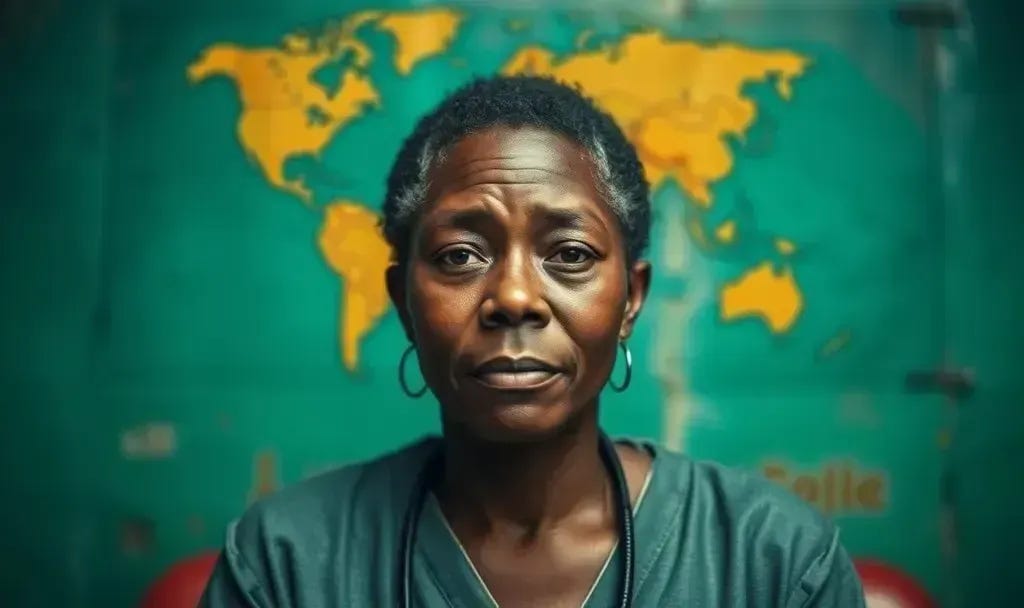
“The default patient”
Global medicine has always had a default patient, and it has never been African.
The pattern goes back further than medicine itself. In the 1950s, Kodak calibrated film stock using a reference photograph known as the Shirley card, a white model against a neutral background, used to set exposure and color balance for every camera sold. For decades, if you weren’t that skin tone, the camera simply wasn’t built to render you accurately. Nobody in the room making the calibration decisions was affected by getting it wrong, so it never got fixed until much later.
Medicine ran the same experiment, at far higher stakes, for far longer.
Roughly 78 to 86% of all genome-wide genetic research has been conducted in people of European ancestry. People of African ancestry, who hold more genetic diversity than any other population on Earth, account for somewhere between 1 and 2 percent. The polygenic risk scores now used to predict disease risk in precision medicine are built almost entirely on this skewed foundation, overrepresenting European ancestry by roughly 460 percent relative to global population share, while African ancestry sits at only around 17 percent of what equal representation would produce.
Clinical trials tell the same story. Black patients made up just 7.4 percent of participants in FDA trials that led to new cancer drug approvals between 2014 and 2018, despite a far higher share of cancer cases, a participation-to-prevalence ratio of 0.31. The drugs still get approved. They just get approved without fully knowing how they behave in every body they’re meant to treat.
Why this breaks prevention specifically
Here’s the part that matters most for a piece about prevention.
Acute medicine has a safety net. If a treatment doesn’t work as expected, a clinician sees it happen in real time and adjusts. Prevention has no such safety net, because prevention is, by definition, trying to catch something before anyone can see it. It depends entirely on the accuracy of the tools doing the catching. If those tools are miscalibrated for a given population, prevention doesn’t fail loudly. It fails silently, and looks like it’s working the whole time.
We already have hard evidence of exactly this failure mode. A 2020 study in the New England Journal of Medicine found Black patients had nearly three times the rate of dangerously low blood oxygen that went completely undetected by pulse oximeters, the small clip-on device used in hospitals worldwide, compared to white patients using the identical device. It took a pandemic, where that same device was used to help decide who received treatment, before the FDA issued a safety warning, in 2021.
This is what “importing” a preventive
health model into Africa actually risks. A scanner built and calibrated entirely on European and American bodies doesn’t stop working in Harare, Lagos or Cape Town. It just starts quietly missing things, while looking exactly as sophisticated as it does everywhere else.
Why now
Three things are converging at once, and none of them existed together five years ago.
The first is capital validation. Neko Health’s raise proves, at a scale nobody can argue with, that global investors believe in preventive-diagnostics-as-data-infrastructure as a category. That appetite currently has zero African-market exposure.
The second is demographic. Africa’s median age is 19.5 years, the youngest of any continent on Earth. Its working-a
ge population is projected to grow from 883 million in 2024 to 1.6 billion by 2050, nearly a quarter of the entire global workforce. Every other preventive health company in the world is built to catch disease accumulating late in life, in aging Western populations. A model built in Africa captures health trajectories at the very start of people’s productive years, data that compounds in value, individually and collectively, for decades. This is the same dynamic African institutions call the demographic dividend, and health is one of the clearest levers for realizing it.
The third is market size, and it’s larger than most people realize. Combine U.S. Black consumer spending, roughly $1.8 to 2.1 trillion, with Africa’s own household and business consumption, approaching $4 trillion, and you get a blended global Black buying power somewhere in the range of $3 to 4 trillion a year. Despite that scale, McKinsey research describes serving Black consumers as a $300 billion opportunity precisely because they remain chronically underserved, with healthcare among the categories where the gap is widest.
Put those three together and the opportunity isn’t “a wellness clinic for Zimbabwe.” It’s the first serious infrastructure for a global market that the entire longevity industry has, so far, built around.
What My Thesis Is…
Building a preventive health facility, starting as a single flagship in Harare (or another African City), built on two things at once: comprehensive diagnostic screening for the people who walk through the door, and a data infrastructure layer designed, from day one, to actually include African populations in the datasets that the rest of the industry has left out.
One engine of the business should be a pure consumer play serving the consumer with the right information to help them live happier and healthier lives. The second engine of the business needs to have a B2B angle. This is partnering with institutions to plug that global gap that is African data in healthcare. This has a knock-on effect for the whole world of medicine as it allows for better discovery of drugs, tools and understanding of science as a whole.
Starting with one flagship facility, rather than a network, is deliberate. It proves the clinical model, the data infrastructure, and the partnership thesis before any capital gets committed to scaling something unproven.
Bringing what is currently taking off in the West and applying it to an African Market.
This is something that I think about quite a lot and I hope to see this come to fruition
The stakes
None of this closes on its own, and the direction it’s currently heading is the wrong one.
As AI takes on a larger role in how healthcare decisions get made, everywhere in the world, the default patient problem doesn’t shrink. It compounds, because AI learns from the data that already exists, and the data that already exists has the exact shape of the gap this piece has walked through. Every year the rest of the industry moves faster on longevity and prevention without African data in the foundation, the harder that gap becomes to close later, and the more expensive it becomes to correct.
The fixes that do exist right now, initiatives like H3Africa building African genomic datasets, medical bodies slowly stripping race-based corrections out of clinical algorithms, all share the same shape: they’re corrections, arriving years after the original tools were already built and already deployed. That’s the pattern I don’t think we can afford to repeat with the next generation of preventive health infrastructure.
The default patient problem doesn’t get solved by asking to be included later. It gets solved by building the data, and the infrastructure that collects it, from the start, with the population it’s meant to serve. That’s the bet my thesis for Preventative Health in Africa is built on.